Fine Tuning does NOT prove God (no-maths version, words only)
Stop being ignorant about Bayesian statistics. It does not prove the existence of a God.
August 30, 2026
Stop being ignorant about Bayesian statistics. It does not prove the existence of a God, whatever type of Conscious Creator that may be.
I recently re-discovered Alex O’Connor on the dreaded website YouTube.com. I’d completely forgotten about him for a couple years but his podcast Within Reason is fire fr. And thus, here I am in the year of our Lord 2026, explaining statistics to you because of a clip from years ago, and an argument that still seems convincing to people.
Philip Goff in conversation with Alex O’Connor on “Debating God With The Archbishop of Canterbury, Philip Goff, and Elizabeth Oldfield” mentions around 20 mins in:
“In our standard ways of understanding evidence, with something called Bayes theorem, this is evidence of some kind of goal directedness in the early universe. I think we’re in denial about this as a society. I think it’s a little bit like when we first got evidence that we’re not in the center of the universe.”
I like religion. I go to church. I sing in choir. Now let me argue against God’s existence, but not to discourage you from any religious practice you may have. May your life be filled with love and light.
The Fine-Tuning Argument
Let me lay out the finetuning argument for you as I understand it. The universe seems to abide by certain constants that have to be precisely what they are. Like the speed of light in a vacuum, elementary charge, and the gravitational constant. E.g. if you were to increase the strength of gravity by the tiniest amount, the universe would not be able to exist.
Big donk, universe gone, type beat.
And thus, it is so improbable that the universe exists, that it must be the hand of God.
One quick common objection against the fine-tuning argument is that because there seem to be these tight constraints on when life can occur (these universal constants must be exactly right), that means it wasn’t made by a God. Why would God make these constraints so tight? Why would he not be able to blow life into anything? God doesn’t have constraints, right?
As a Calvinist, this objection doesn’t hold up for me. We cannot understand God, so we cannot understand why these constraints are here. The fact that there are tight constraints does not disprove God. But now as a scientist, will give 3 reasons for why The Fine-Tuning Argument does not prove the existence of a God.

Part 1: The right tool?
Bayesian statistics is used to assign (and update) probabilities to propositions. So you start with a belief about something. Then new evidence presents itself, and you update your belief. Bayesian stat. is all about updating beliefs. Some common uses for this are:
- Clinical trials
- A/B testing for web products
- Autonomous-vehicle localization and mapping
- Sports (analytics playoff odds)
- Ecological population estimation
- Financial portfolio optimisation and risk forecasting
- Quality control in manufacturing
I’m mostly familiar with clinical trials, as I had to use Bayesian statistics for my psychology degree. Bayesian stat. is a way to ‘play the odds’. A Bayesian asks: What’s the probability the hypothesis is true given the data?
And in certain cases, this can be done very effectively. In clinical trials for example, it is preferred use Bayesian stat. instead of classical (frequentist) methods when the sample size for your trial is small. The Bayesian way of doing things is also standard in drug-dose-finding, rare-disease trials, medical device testing, and vaccine monitoring. It is not a 100% guarantee; it just tells you that A is more likely than B. It is not perfect; it just works most of the time – in certain settings – like clinical trials. Bayesian stat. works great as a tool within this universe, but I don’t think it’s the proper tool to say anything about the creation of the universe.
So, let’s look at Bayes Theorem.
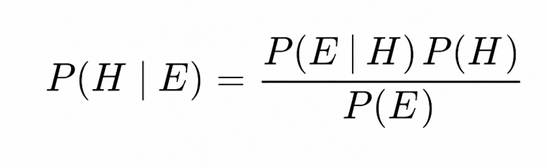
Here it is. Don’t be afraid, I will explain it to you in words. We are doing girlmath here, I promise you will get this.
This formula put into fancy words is:
The probability that a hypothesis is true after observing some evidence equals the probability of observing that evidence if the hypothesis were true, multiplied by how plausible the hypothesis was before seeing the evidence, and then divided by the overall probability of observing that evidence.
Or in normal words:
It asks, how plausible is all this? Taking into account the evidence, the plausibility you already had before the evidence, and the plausibility of seeing this evidence regardless.
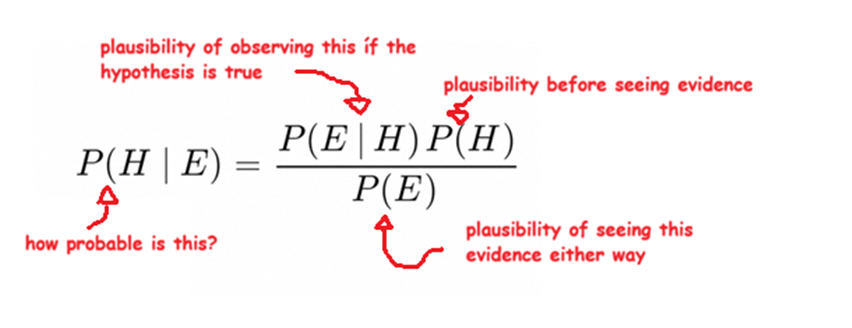
So let’s make it into true girlmath. For the normal maths version check out Fine Tuning does NOT prove God (maths-version).
Let’s say you like this girl called Roxanne. She has been texting you a lot so you think she must be into you! Yippie! This is a rational belief.
But then…. some new evidence presents itself…. Roxanne happens to be a very active texter. What you perceived as someone giving a lot of their time to you turned out to be more of a habit from them. You are but one of many Roxanne is texting this much.
At first, you believe there is a high probability Roxanne likes you. Then you update your belief, using:
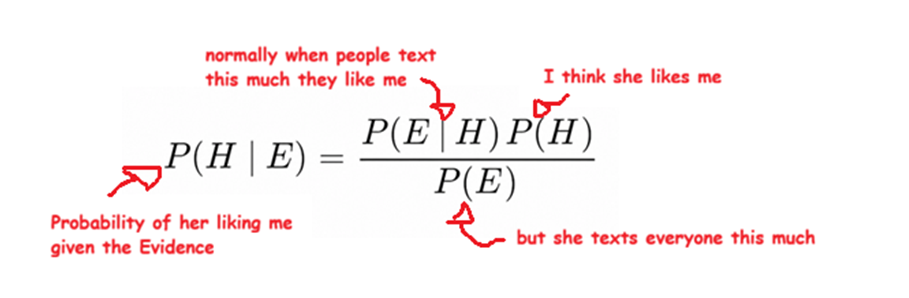
The probability of her liking you goes down. Intuitively this makes sense right?
We still don’t know for certain; these are all just playing odds. But our belief is now updated.
I recommend watching this video for another example.
So we need a couple things to plug into this formula. We need:
- The probability of our prior belief (the hypothesis)
- The probability of seeing the evidence regardless
- The probability of observing the evidence íf the hypothesis is true
What would it look like if we tried to apply this to the literal Creator of the universe?
The hypothesis would be:
Our universe has a conscious creator.
The evidence would be:
There are fundamental physical constants.
And we need our probabilities:
- The probability of our prior belief (the hypothesis)
Let’s just put that to low for now. Since this is our hypothesis, this could be anything, we decide.
- The probability of seeing the evidence regardless
This is where we run into trouble. We do not know the probability of this! The same goes for number three:
- The probability of observing the evidence íf the hypothesis is true
We do not know how likely it is we would see the universal constants íf there is a conscious Creator. We truly do not know.
Bayes’ theorem needs these things. In science these probabilities come from domain knowledge and previous studies. Some examples are:
- Previous production batches typically have a 2% defect rate.
- Disease X is rare (1 in 10,000 people).
- July is usually dry in France.
But questions that encompass our entire universe are impossible to answer using Bayes’ theorem. It is not the right tool for this question and thus cannot prove the existence of God.
(There are ways in Bayesian statistics to deal with lacking data, if you want to argue with me about setting non-informative priors or using mechanistic models to form likelihoods come fight in the comments or email me)
Part 2: A quick one
Even if the exact universal constants are very unlikely, it is the only way it could have gone, because here we are. Assuming we had one chance and one universe, our existence proves only our existence and nothing more. But was there only one chance?
Part 3: Before the Big Bang
Quantum foam is a term coined by J. A. Wheeler in his 1955 Physical Review paper “Geons”. He also worked on the Manhattan project, the Hydrogen bomb, and named the wormhole and blackhole.
Stay with me while I yap about quantum foam, I will visualise all this for you in a second.
Wheeler argued that, on Planck scales(very very very small), space-time must froth with violent quantum fluctuations “quantum foam”. It can be stated that our universe is a fluctuation in that foam ever since Edward P. Tryon came on the scene with his 1973 paper “Is the Universe a Vacuum Fluctuation?”.
Tryon suggested that a complete universe could spontaneously appear as a quantum fluctuation of the pre-existing vacuum (a.k.a. the quantum foam). That means our Big-Bang universe might be just one bubble arising out of that foam.
When I imagine the quantum foam before the Big Bang, I imagine a vast space with charged potential in it. Maybe just take a second to sit and think about this. We are not in OUR SPACE anymore. There isn’t any stuff in this space we are visualising. But there is an underlying current of potential, a very real force. This potential does different things in different places. Here and there it collapses and creates a universe. Many of these are unstable and collapse again pretty much immediately. But repeat this often enough and some, per chance, will survive.
So there it is, this bubbling quantum foam, until one day it creates the universe with our galaxies and solar systems and now here we are, talking. No deliberate design was needed to create this incredible unlikely, magical, beautiful thing. No deliberate design was needed and that is okay. I think this process sounds wonderful; it sounds beautiful. It doesn’t make existence any less magical for me.
Now you can ask “But where did the quantum foam come from?” and that’s valid. But we came here today to discuss the universal constants. And I see no proof of God’s existence in the universal constants smh.
And as seen in part 1, even if we assume there is only one universe with one chance of it being created, Bayesian statistics still cannot prove the existence of a Conscious Creator.
You made it to the end!
Now what practical application does this have? None. I just got triggered by people claiming that the Universal Constants prove God. They do not. Furthermore, I don’t want to use science to prove God. To me, God is the thing that we cannot yet put into words. It is what we know is right and true without completely understanding it yet. God will always be just out of reach. Nevertheless, it gives us something to aim towards. Our running isn’t futile. …. the real God is the friends we made along the way imma right ….
Okay thank you for listening, see you next time! <3
Papers mentioned
J. A. Wheeler, “Geons,” Physical Review 97 (1955) 511-536
Edward P. Tryon, Nature 246, 396 (1973)